
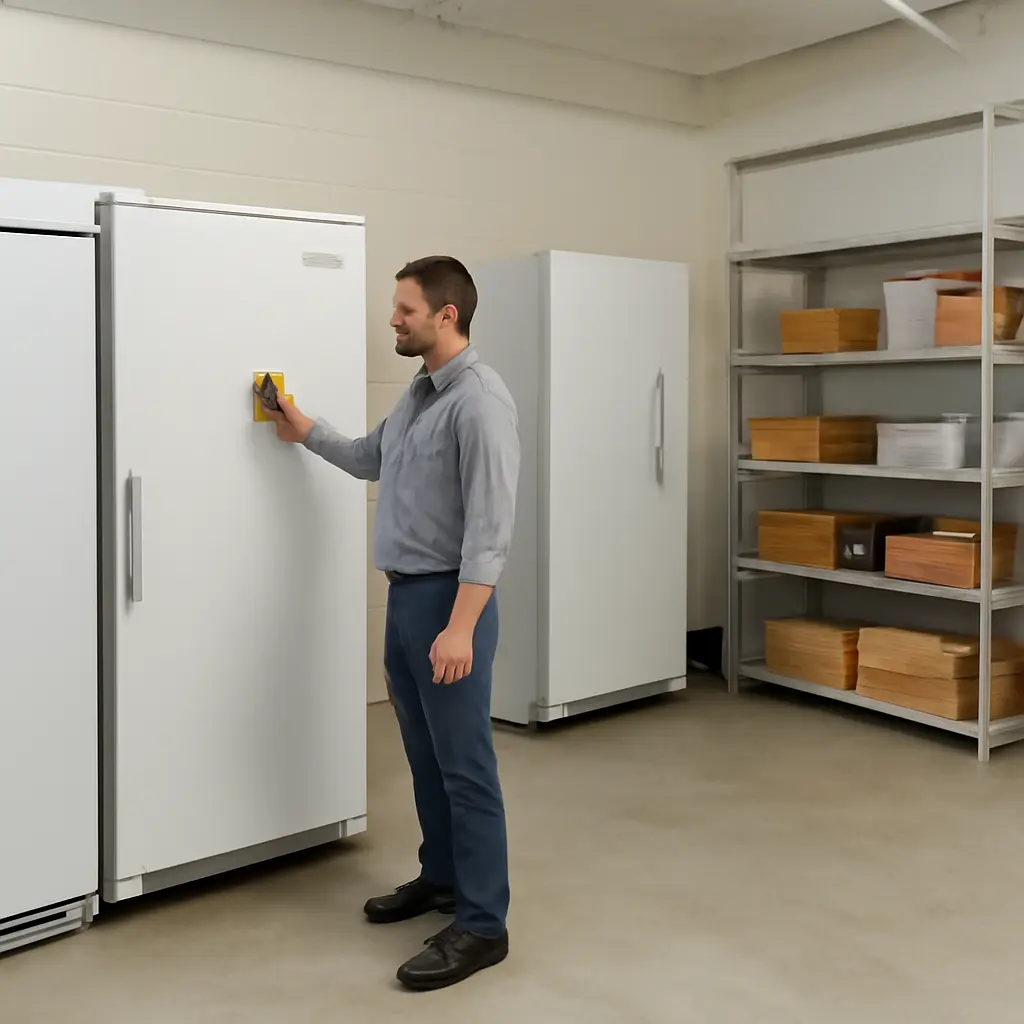
Temperature-stable device storage solutions are systems that protect equipment from temperature conditions that can impair its performance, reliability, or service life. Choosing one starts with identifying the device’s permitted storage range and the risks it faces, then matching those needs to an insulated enclosure, controlled room, or actively cooled or heated cabinet. The distinction matters: the U.S. Food and Drug Administration (FDA) requires manufacturers to define appropriate storage conditions for regulated products, while batteries and electronic components can also be affected by heat, cold, and temperature cycling. This guide explains storage requirements, solution types, selection criteria, monitoring, and practical implementation.
Temperature-stable storage protects device condition
Temperature-stable storage means maintaining environmental conditions within a specified range for a defined period, with acceptable variation and documented evidence where needed. It does not necessarily mean holding one exact temperature: a solution is stable when it keeps the stored device within its manufacturer’s limits despite expected room conditions, door openings, power interruptions, and seasonal changes.
The required range is product-specific. A medical device, lithium-ion battery, optical instrument, and consumer electronic may have different limits, and the permitted operating range may differ from the permitted storage range. The device label, user manual, safety data sheet, or manufacturer’s technical documentation should therefore be the starting point—not a generic assumption that all electronics should be stored at room temperature.
Temperature control is also only one part of protection. Humidity, condensation, dust, vibration, electrostatic discharge, light, and physical security can matter as much as temperature. A cabinet that holds temperature but allows moisture to condense on cold equipment may create a new failure risk rather than solve one.
Storage requirements define the temperature-stable solution
A storage requirement is the manufacturer- or application-defined set of environmental conditions under which a device can be stored without unacceptable loss of safety, performance, or usable life. The FDA’s guidance on medical-device labeling emphasizes that instructions and warnings should provide information needed for safe and effective use; for a particular device, its own labeling and validated documentation take precedence over general storage advice.
Requirements may specify a temperature range, maximum duration outside that range, humidity limits, light protection, or handling steps before reuse. For batteries, storage state of charge and periodic inspection may also be relevant. For sensitive instruments, calibration status and protection from shock or contamination may be critical.
Specified temperature range
The specified temperature range is the documented lower and upper boundary for storage. It should be taken directly from the device’s instructions and distinguished from its operating range, which applies while the device is powered or in use. If documentation gives a range such as 5–30°C, that does not automatically establish that every point in the storage space stays within that range; the actual environment must be measured where the device is kept.
The World Health Organization’s guidance for temperature-sensitive pharmaceutical products illustrates the importance of product-specific limits and controlled distribution. Although drug-storage rules should not be applied indiscriminately to devices, the same practical principle holds: define the acceptable range from authoritative product documentation, and preserve evidence that conditions remained acceptable.
Temperature excursions and cycling
A temperature excursion is a period when conditions fall outside the specified range. Temperature cycling refers to repeated changes between warmer and cooler conditions. Both may matter: a brief excursion could be harmless for one device but damaging to another, while repeated cycling can contribute to condensation, material stress, or battery aging.
Do not decide that an excursion is acceptable solely because it was short. Record the minimum and maximum temperature, duration, affected items, and relevant environmental conditions, then consult the manufacturer’s guidance or a qualified technical lead. For regulated inventory, follow the organization’s formal deviation and disposition procedure.
Temperature stability versus temperature uniformity
Stability describes how much temperature changes over time at a point; uniformity describes how much it differs from one location to another. A cabinet can have a steady average reading yet still contain warm or cold spots. Verification should therefore consider sensor placement and, when the risk warrants it, temperature mapping across shelves and storage zones.
This distinction provides a bridge from requirements to equipment choice: once the acceptable range and likely variation are known, the storage method can be selected according to how much control the environment demands.
Storage solutions range from passive protection to active control
Temperature-stable storage solutions fall into three broad categories: passive insulation, controlled ambient spaces, and actively conditioned enclosures. These are hyponyms of the broader storage-solution category, and each offers a different balance of cost, precision, capacity, and operational complexity. The correct choice depends on the device limits, the surrounding climate, storage duration, and the consequences of failure.
Insulated cases and passive containers
A passive container slows heat transfer but does not independently maintain a set temperature indefinitely. Examples include insulated cases, thermal shipping containers, and protective packaging with validated phase-change materials. These are useful for transport, short-term staging, or modest fluctuations when the container has been qualified for the expected duration and ambient conditions.
Passive protection is not a substitute for checking the device’s requirements. Container performance depends on insulation, payload, starting temperature, ambient exposure, and how often it is opened. For critical shipments, use the supplier’s validated packing configuration and temperature-monitoring procedure rather than improvising with household coolers or ice packs.
Climate-controlled rooms
A climate-controlled room uses building heating, ventilation, and air conditioning (HVAC) to keep a larger space within a planned environmental range. It is appropriate when many devices share similar requirements or when equipment is too large for cabinet storage. Its effectiveness depends on building controls, room layout, air circulation, maintenance, and the location of stored items relative to windows, vents, exterior walls, and heat-producing equipment.
Room thermostats alone may not prove that every storage location remains compliant. Where the risk justifies it, place calibrated monitoring instruments at representative locations and verify conditions under realistic operating conditions, including overnight periods and seasonal extremes.
Refrigerated or heated cabinets
An actively conditioned cabinet uses refrigeration, heating, or both to control a smaller storage volume. It can offer more localized control than a room and may include alarms, data logging, access control, or backup-power connections. The equipment must be designed for the intended use: domestic refrigerators, for example, may have uneven temperatures and are not automatically suitable for regulated or precision storage.
Select a cabinet with a usable operating range that covers the required set point and expected ambient conditions. Review its capacity, recovery after door openings, temperature uniformity, alarm behavior, maintenance needs, and the manufacturer’s intended application. Avoid overloading shelves or blocking air circulation, which can undermine performance.
Battery-specific storage arrangements
Battery storage combines temperature control with electrical and fire-safety considerations. The U.S. Department of Energy’s battery research explains that temperature influences battery performance and degradation, but the recommended storage conditions vary by chemistry and product. Follow the battery maker’s guidance on temperature, state of charge, inspection, isolation, and charging; do not assume one storage rule applies to every lithium-ion battery.
For large battery inventories or energy-storage systems, consult applicable fire codes, local authorities, and qualified safety professionals. Temperature-stable storage does not by itself address electrical shorts, damaged cells, thermal runaway, or safe separation and response planning.
Selection depends on risk, capacity, and evidence
Choosing a solution is a risk-based process: establish the device limits, assess the storage environment, compare protection options, and define how performance will be verified. A low-cost solution can be appropriate for robust equipment in a stable room, while high-value, safety-critical, or regulated devices may justify monitored active control and documented procedures.
Match the solution to the device and environment
Begin by collecting each device’s storage range, humidity limits, allowable excursion guidance, packaging instructions, and shelf-life or maintenance requirements. Then assess the actual storage location: seasonal highs and lows, sunlight, nearby heat sources, ventilation, power reliability, door traffic, and the duration of storage.
- Use passive insulation for qualified, time-limited protection during transport or staging.
- Consider HVAC-controlled rooms for larger inventories with compatible requirements.
- Consider a monitored cabinet when tighter localized control or separation is needed.
- Choose a purpose-designed solution when regulatory, safety, or manufacturer requirements call for one.
Consider humidity, condensation, and packaging
Relative humidity is the amount of water vapor in air compared with the maximum it can hold at that temperature. Cooling air raises the risk of condensation when equipment is moved into a warmer, humid environment. Follow the manufacturer’s instructions for acclimation, packaging, and desiccants; keep devices sealed during temperature transitions when directed, and avoid adding moisture-control materials that could introduce contamination or violate product instructions.
The U.S. Environmental Protection Agency notes that moisture control is central to preventing indoor dampness and mold. While mold is not the only concern for device storage, uncontrolled moisture can also contribute to corrosion, packaging damage, and electrical problems.
Compare lifecycle cost and operational resilience
Purchase price is only one cost. Include installation, calibration, energy use, maintenance, alarm response, spare parts, backup power, and the cost of product loss or downtime. A highly capable cabinet is not resilient if no one receives its alarms or if a power failure goes unnoticed.
For critical storage, consider a contingency plan: an alternate qualified location, a defined transfer method, emergency contacts, and clear authority to quarantine or release affected devices. The plan should reflect the allowed excursion time and manufacturer advice rather than a generic emergency threshold.
Monitoring and maintenance make storage verifiable
Monitoring is the measurement and review of storage conditions over time. It turns an assumed capability into evidence that the environment is performing as intended. The level of monitoring should match the consequences of failure: occasional checks may be sufficient for low-risk items, while critical stock may need continuous logging, alarms, review, and documented response.
Use suitable sensors and placement
A thermometer or data logger should have a suitable measurement range, accuracy, resolution, and calibration status for the application. Place sensors where stored devices actually experience conditions, not only beside a thermostat or directly in the path of conditioned air. In larger rooms or cabinets, use mapping or multiple locations when gradients are plausible.
The National Institute of Standards and Technology (NIST) explains that measurement traceability is established through a documented calibration chain to recognized standards. In practice, use instruments with appropriate calibration records and follow the device or quality system’s requirements for recalibration and checks.
Set alarms and define response steps
An alarm is useful only when its limits are appropriate and a person can act on it. Set alert thresholds based on the device’s documented range, the monitoring instrument’s uncertainty, and the time needed to respond. Document who receives alerts, how quickly they must respond, where affected devices are moved, and how excursion decisions are made.
- Check and record the event’s start and end times, minimum and maximum readings, and sensor status.
- Identify potentially affected devices and segregate them when appropriate.
- Consult manufacturer guidance and the organization’s quality or safety procedure.
- Document the disposition, corrective action, and any required notification.
Maintain equipment and review records
Preventive maintenance can include cleaning, inspection of seals and vents, checking door closures, testing alarms, reviewing data, and servicing HVAC or refrigeration components according to the equipment maker’s schedule. Keep calibration certificates, maintenance records, temperature logs, excursion reports, and corrective actions together so that performance can be reviewed over time.
A useful visual aid is a temperature-monitoring chart showing the acceptable band, recorded readings, alarm thresholds, and any excursions. For a room or large cabinet, a temperature map can show spatial differences that a single sensor would miss.
Practical implementation turns requirements into routine
A small clinic storing diagnostic equipment, for example, should not assume that every device belongs in a refrigerator. Staff should check each device’s labeling, separate items with different requirements, and use monitored refrigeration only where the manufacturer specifies it. A field-service team transporting instruments may instead use a validated insulated case with a logger and a documented maximum transit time.
A battery-storage area provides another example. The operator should follow the battery manufacturer’s storage instructions, keep the area within the prescribed conditions, inspect stored units as directed, and establish an emergency response plan consistent with local fire and electrical-safety requirements. These examples show why a single “best temperature” does not exist: the appropriate solution follows the device’s intended use and documented limits.
Conclusion: Start with specifications, then verify performance
Temperature-stable device storage begins with a clearly defined storage requirement and a realistic assessment of environmental risk. Passive containers, climate-controlled rooms, actively conditioned cabinets, and battery-specific arrangements serve different purposes; selection should account for temperature range, stability, uniformity, humidity, capacity, cost, and resilience. Monitoring, calibrated instruments, maintenance, and a written excursion response make the system dependable and auditable.
Before purchasing equipment, review the manufacturer’s storage instructions, document the conditions at the proposed location, and identify how you will detect and respond to excursions. For regulated or safety-critical devices, consult the relevant quality, engineering, and safety professionals and use the applicable standards and local requirements.
Sources: U.S. Food and Drug Administration, Medical Device Labeling, https://www.fda.gov/medical-devices/overview-device-regulation/medical-device-labeling; World Health Organization, Model Guidance for the Storage and Transport of Time- and Temperature-Sensitive Pharmaceutical Products, https://www.who.int/publications/m/item/model-guidance-for-the-storage-and-transport-of-time-and-temperature-sensitive-pharmaceutical-products; U.S. Department of Energy, Batteries, https://www.energy.gov/eere/vehicles/batteries; U.S. Environmental Protection Agency, Mold Course Chapter 2: Moisture Control, https://www.epa.gov/mold/mold-course-chapter-2; National Institute of Standards and Technology, Metrological Traceability, https://www.nist.gov/metrology/metrological-traceability.