
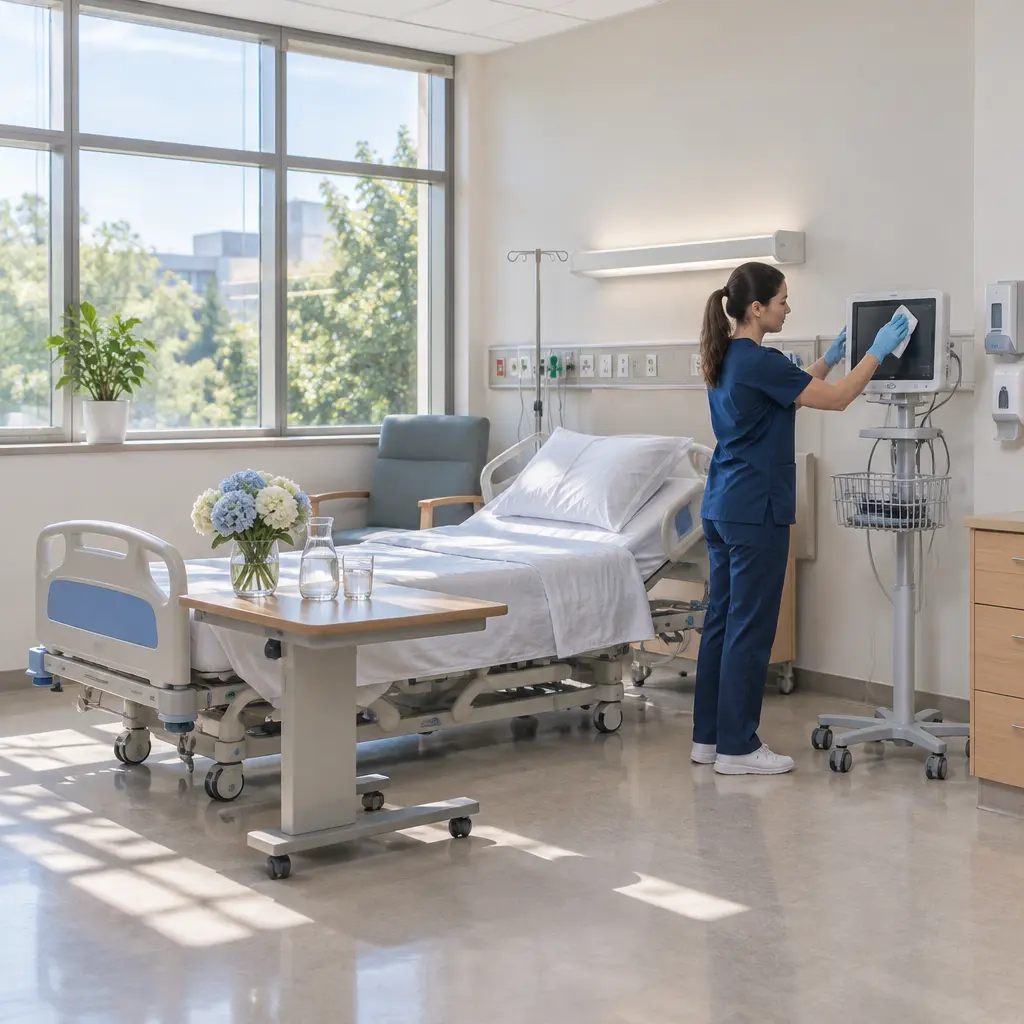
Hospital device disinfection is the cleaning and application of an appropriate antimicrobial process to reusable equipment and surfaces so they do not carry infectious organisms from one patient or care area to another. It is a core part of infection prevention: the World Health Organization estimates that, in acute-care hospitals, about 7 in 100 patients in high-income countries and 15 in 100 patients in low- and middle-income countries acquire at least one health care-associated infection during their stay. Safe practice depends on matching the method to the device’s risk, following manufacturer instructions, and completing the process reliably. The sections below explain how device risk is classified, how cleaning and disinfection differ, which methods are used, and how hospitals can monitor performance and learn from outbreaks.
Risk classification defines device disinfection requirements
The Centers for Disease Control and Prevention (CDC), drawing on the Spaulding classification system, describes reprocessing requirements according to the infection risk associated with a device’s intended use. The central distinction is whether equipment contacts sterile tissue, mucous membranes, or intact skin. This classification helps determine whether an item requires sterilization, high-level disinfection, or lower-level disinfection; it does not replace the device manufacturer’s instructions or a facility’s infection-control policy.
Critical devices: sterilization is required
Critical devices enter sterile tissue or the vascular system, such as surgical instruments and certain implants. Because microorganisms remaining on these items could cause serious infection, they must be sterilized before use. Sterilization is a validated process intended to destroy all forms of microbial life, including bacterial spores. Disinfection alone is not an adequate substitute for sterilizing a device classified as critical.
Semicritical devices: high-level disinfection is generally required
Semicritical devices contact mucous membranes or nonintact skin without ordinarily penetrating sterile tissue. Examples include many endoscopes and respiratory therapy equipment. The CDC states that these devices require at least high-level disinfection, which eliminates all microorganisms except potentially large numbers of bacterial spores. The exact process depends on the device, its materials, the disinfectant’s approved use, and the manufacturer’s instructions.
Noncritical devices: disinfection must match contact and contamination
Noncritical devices contact intact skin or do not directly touch patients. Examples include blood-pressure cuffs, bedside tables, and some monitoring equipment. These items generally require cleaning and low- or intermediate-level disinfection, with the choice guided by the patient-care setting and visible contamination. Shared equipment should be disinfected between patients, while frequently touched surfaces may need more frequent attention under facility policy.
Risk classification establishes the required endpoint; achieving it depends on carrying out the full reprocessing sequence. In particular, disinfection cannot reliably compensate for soil left on a device.
Cleaning and disinfection work together to interrupt transmission
Cleaning removes visible soil and organic material, usually through water, detergent, and mechanical action. Disinfection uses a chemical or physical process to inactivate specified microorganisms on an object. The CDC emphasizes that thorough cleaning must precede high-level disinfection and sterilization because blood, tissue, and other residues can shield organisms or interfere with processing. In practice, “clean first, then disinfect or sterilize” is a safety sequence, not a choice between competing approaches.
Manual cleaning and inspection
Manual cleaning involves following device-specific instructions for disassembly, brushing, flushing, rinsing, and drying. Staff should inspect the device for remaining soil, damage, or components that could prevent effective processing. Hinges, channels, joints, and other hard-to-reach features deserve particular attention. If a device cannot be adequately cleaned or is damaged, it should not be returned to service until the concern is resolved.
Disinfectant contact time and compatibility
A disinfectant’s efficacy depends on using the product for the labeled purpose and maintaining the required concentration, temperature, and contact time. Staff should not assume that a product effective on a hard environmental surface is suitable for a patient-care device. The U.S. Environmental Protection Agency registers antimicrobial products for specified uses, while device manufacturers provide reprocessing instructions for their equipment. Hospitals should verify that the disinfectant, device, and process are compatible.
Drying, storage, and transport
Reprocessing continues after the disinfection cycle. Devices must be handled, dried, and stored in ways that prevent recontamination, and transported in a manner that separates contaminated equipment from clean or processed items. For devices with internal channels, effective drying is especially important because retained moisture can support microbial growth. A completed cycle is not proof of safe use if subsequent handling compromises the device.
The same principles apply beyond reusable instruments. Shared equipment and frequently touched surroundings can act as links in transmission pathways, so facilities need clear routines for both device reprocessing and environmental cleaning.
Shared equipment and environmental surfaces require reliable routines
Hospital equipment can be contaminated during routine care and may transfer organisms if it is shared without appropriate cleaning and disinfection. CDC environmental infection-control guidance distinguishes patient-care equipment from environmental surfaces but stresses that both require procedures suited to their use and contamination risk. The practical goal is a dependable handoff: identify who cleans an item, when it must be cleaned, which product is approved, and how completion is documented when needed.
Shared patient-care equipment
Items such as thermometers, mobile vital-sign monitors, and wheelchairs may move between patients or rooms. They should be disinfected between uses according to their instructions and local policy. Clear responsibility matters: when staff assume someone else has cleaned an item, the process can be missed. Hospitals can reduce ambiguity with labeled workflows, accessible wipes or reprocessing areas, and training for everyone who handles the equipment.
High-touch surfaces around patients
Bed rails, call buttons, overbed tables, and equipment controls are examples of high-touch surfaces that may be contaminated through hands or patient-care activity. The CDC recommends cleaning and disinfecting surfaces at a frequency appropriate to the care area and risk. During outbreaks or when a patient is known to carry a particular pathogen, facilities may use organism-specific procedures and enhanced monitoring.
A practical workflow for staff
A dependable routine makes the required action easy to identify and verify. Hospitals can use the following sequence as a framework, adapting it to each device and approved procedure:
- Identify whether the item is critical, semicritical, or noncritical and consult its current instructions for use.
- Remove visible soil using the specified cleaning method before disinfection or sterilization.
- Apply an approved process at the required concentration, temperature, and contact time.
- Rinse, dry, inspect, and store the item as instructed, preventing clean and contaminated equipment from crossing paths.
- Document required cycle details and report equipment damage, process failures, or supply shortages.
These steps are only effective when supported by staff training, adequate supplies, and quality checks. Outbreak investigations show why oversight and correct reprocessing matter particularly for complex devices.
Outbreak investigations demonstrate the consequences of reprocessing failures
A contaminated or inadequately reprocessed device can expose multiple patients before the problem is recognized. Complex reusable devices may have narrow channels or intricate surfaces that are difficult to access, making adherence to cleaning and drying instructions essential. Public health investigations have documented infections associated with lapses in endoscope reprocessing, prompting hospitals and regulators to strengthen protocols, training, and surveillance.
Duodenoscope-associated infection risks
Duodenoscopes are flexible instruments used in procedures involving the digestive tract. Their complex design can make cleaning difficult, and the U.S. Food and Drug Administration has addressed infection risks through safety communications and recommendations concerning reprocessing and device design. The example illustrates a broader lesson: when a device is difficult to clean consistently, facilities must follow its validated instructions carefully, verify staff competency, and promptly investigate suspected transmission.
Surveillance and response
When a possible device-associated infection is identified, infection-prevention teams may review patient histories, device-use records, reprocessing logs, and laboratory findings. A timely response can include removing a device from service, checking equipment and procedures, notifying public health authorities when required, and assessing whether other patients may have been exposed. Reliable traceability helps teams connect a patient, device, and processing cycle without delay.
Lessons from outbreaks reinforce that written policies alone are insufficient. Hospitals need ongoing education and observable evidence that procedures are being completed as intended.
Training and quality assurance make disinfection dependable
Quality assurance is the organized evaluation of whether cleaning and disinfection procedures are followed and achieve their intended results. The CDC’s infection-control guidance supports staff education, written procedures, appropriate product use, and monitoring. A strong program combines competency assessment with practical checks rather than relying solely on annual reminders or the presence of a completed checklist.
Competency-based training
Personnel who clean or reprocess devices need training relevant to the equipment they handle, including safe chemical use, required protective equipment, and the steps for cleaning, disinfection, or sterilization. Competency should be assessed before independent work and revisited when devices, products, or instructions change. Staff should know how to pause and seek guidance when instructions are unclear or a process fails.
Monitoring and corrective action
Facilities can monitor performance through direct observation, review of processing records, inspection of equipment, and checks that verify cleaning steps. Results should lead to corrective action, such as refresher training, workflow redesign, or repair of equipment. Useful indicators may include completion of required documentation, observed adherence to steps, and the time taken to address reported failures. These measures evaluate the process; they should not be mistaken for direct proof that every device is free of pathogens.
Resources and shared accountability
Effective reprocessing requires sufficient staff, appropriate sinks and equipment, approved products, and time to complete each step. Infection preventionists, sterile-processing teams, environmental-services staff, clinicians, facilities managers, and hospital leaders all contribute. Clear role assignments and a nonpunitive way to report near misses help identify problems before they reach patients.
Conclusion: consistent device disinfection protects patients and staff
Hospital device disinfection is most effective when risk classification guides the required level of processing, cleaning precedes disinfection, and staff follow validated instructions through drying, storage, and handling. Shared equipment and high-touch surfaces need clear routines, while outbreak investigations show the importance of traceability and rapid response. With health care-associated infections affecting a substantial share of hospitalized patients worldwide, reliable reprocessing is a practical patient-safety priority. Hospitals should review device instructions and local policies, train and assess staff, monitor performance, and address gaps promptly; patients and caregivers can also ask how shared equipment is cleaned between uses.
Sources: World Health Organization, Health care-associated infections, https://www.who.int/news-room/fact-sheets/detail/health-care-associated-infections; Centers for Disease Control and Prevention, Guideline for Disinfection and Sterilization in Healthcare Facilities, https://www.cdc.gov/infection-control/hcp/disinfection-sterilization/; Centers for Disease Control and Prevention, Core Infection Prevention and Control Practices for Safe Healthcare Delivery in All Settings, https://www.cdc.gov/infection-control/hcp/core-practices/; U.S. Environmental Protection Agency, Pesticide Registration: Antimicrobial Products, https://www.epa.gov/pesticide-registration/antimicrobial-pesticide-registration; U.S. Food and Drug Administration, Supplemental Measures to Enhance Duodenoscope Reprocessing, https://www.fda.gov/medical-devices/reprocessing-reusable-medical-devices/supplemental-measures-enhance-duodenoscope-reprocessing