
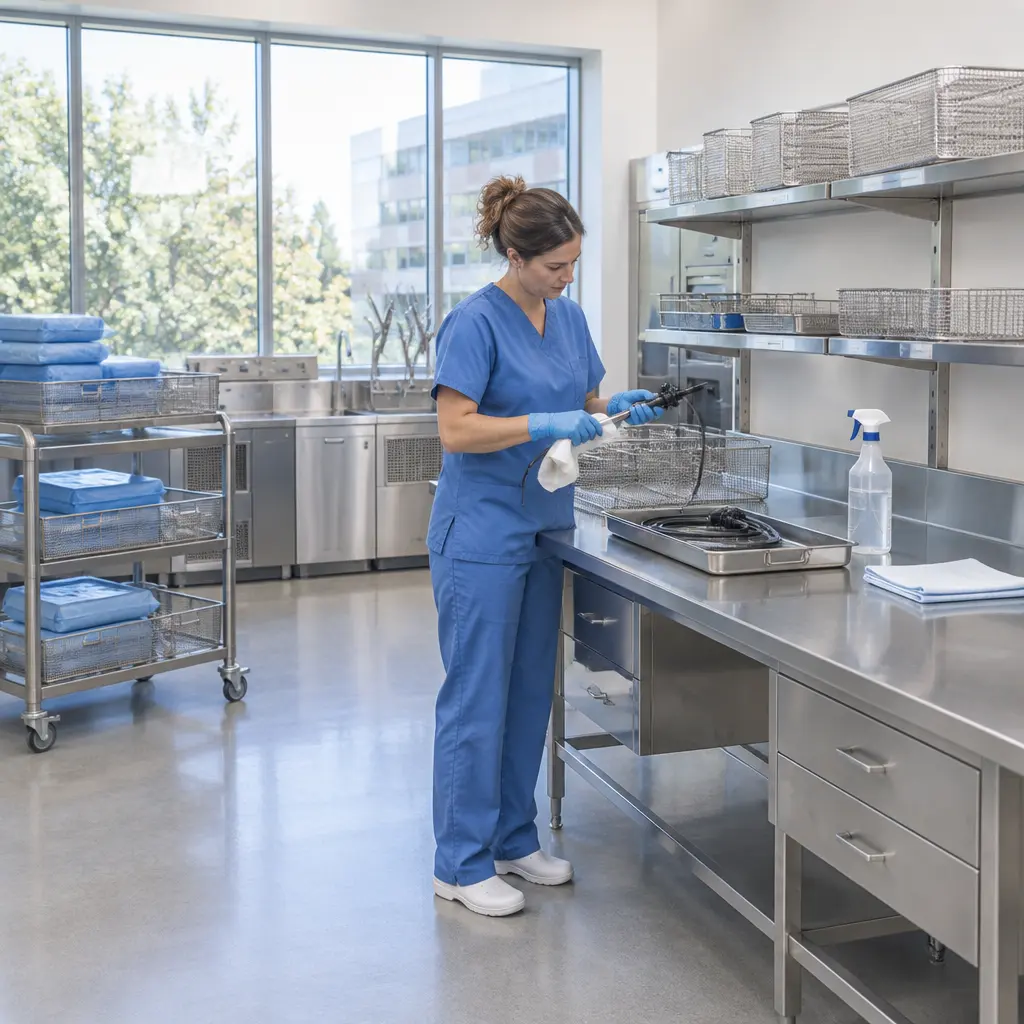
Hospital-grade disinfection is the validated use of a device-appropriate process to reduce or eliminate microorganisms on medical equipment. It does not mean applying the strongest disinfectant to every device: safe reprocessing depends on how a device is used, what it is made of, and the manufacturer’s instructions. The Centers for Disease Control and Prevention (CDC) classifies patient-care items by infection risk, while the U.S. Food and Drug Administration (FDA) evaluates sterilization and disinfection claims and the Environmental Protection Agency (EPA) registers many surface disinfectants. Together, these principles guide cleaning, low- and intermediate-level disinfection, high-level disinfection, sterilization, and quality checks—steps essential to preventing healthcare-associated infections and protecting patients and staff.
Risk classification defines hospital-grade disinfection for medical devices
The CDC’s Spaulding classification groups reusable medical devices according to the infection risk associated with their intended use. This framework is the starting point for choosing a reprocessing level; “hospital-grade” is not, by itself, a single universal process or guarantee that a product is appropriate for every device.
Critical devices: sterilization
Critical devices enter sterile tissue or the vascular system, so they must be sterile when used. Examples include surgical instruments, implants, and certain biopsy instruments. Sterilization destroys all forms of microbial life, including bacterial spores, when a validated process is correctly performed. Depending on device compatibility, methods may include steam, ethylene oxide, or other FDA-cleared approaches. Cleaning comes first: residual soil can obstruct the sterilant’s contact with device surfaces.
Semicritical devices: high-level disinfection at minimum
Semicritical devices contact mucous membranes or nonintact skin but do not normally penetrate sterile tissue. Examples include many flexible endoscopes and respiratory therapy equipment. CDC guidance calls for at least high-level disinfection after cleaning, although sterilization is appropriate when feasible and compatible. High-level disinfection inactivates vegetative bacteria, mycobacteria, fungi, and viruses, but may not reliably destroy large numbers of bacterial spores.
Noncritical devices: low- or intermediate-level disinfection
Noncritical devices contact intact skin or do not directly contact patients. Examples include blood-pressure cuffs, stethoscopes, and some external monitors. The required process depends on the device, contamination, and clinical use. CDC recommendations generally call for cleaning and low-level disinfection; intermediate-level products may be needed when blood or other potentially infectious material is present, in accordance with applicable instructions and policy.
Cleaning is the foundation of effective medical-device disinfection
Cleaning removes visible soil and organic material, usually with water, detergent or an enzymatic cleaner, and mechanical action. It is distinct from disinfection and sterilization, and it is a prerequisite for both. The CDC’s disinfection and sterilization guidance emphasizes that blood, tissue, and other residue can interfere with the effectiveness of subsequent processes.
Point-of-use care and timely transport
Point-of-use care means taking the initial steps specified by the device manufacturer soon after use—for example, removing gross soil or keeping it from drying. Staff then transport contaminated devices in a way that contains contamination and protects people handling them. Prompt, correct pretreatment can make later cleaning more reliable, particularly for devices with narrow channels, joints, or complex surfaces.
Manual and automated cleaning
Manual cleaning uses prescribed brushes, flushing, detergent, and rinsing steps; automated equipment can provide more consistent exposure to cleaning conditions when the device is compatible. Neither method should be assumed suitable for every product. Staff must follow the device and equipment manufacturers’ instructions for use (IFUs), including detergent selection, water quality, temperature, channel brushing, and rinse requirements.
Disinfection methods must match the device and its intended use
Disinfection reduces microorganisms on inanimate objects, but the required level varies by risk category and product claims. EPA-registered surface disinfectants are intended for uses stated on their labels; FDA-cleared or approved processes and devices may apply to reprocessing certain medical equipment. Registration or clearance does not mean a chemical is compatible with every material or device.
Low- and intermediate-level surface disinfection
Environmental surface products are used on specified surfaces, while compatible noncritical medical devices may have their own validated instructions. The labeled contact time matters: the surface generally must remain visibly wet for the duration stated on the label. CDC guidance also distinguishes products with claims against specific organisms, so facilities should select a product appropriate to the suspected or confirmed pathogen and the surface being treated.
High-level disinfection of semicritical devices
High-level disinfection typically uses a liquid chemical process or a validated automated system. The process must meet the product label and device IFU for concentration, temperature, exposure time, rinsing, and drying. For devices with internal channels, all required surfaces must receive the process. CDC guidance advises monitoring reusable high-level disinfectants according to manufacturer instructions, including checking minimum effective concentration where specified.
Sterilization for critical devices
Sterilization uses a validated physical or chemical process to achieve sterility. Steam is widely used for heat- and moisture-compatible devices; low-temperature options may be needed for heat-sensitive products. The appropriate cycle is determined by the sterilizer and device IFUs, packaging, load configuration, and facility validation. A cycle record alone is not enough: facilities also use physical, chemical, and biological monitoring as required by applicable guidance and policy.
Manufacturer instructions and staff competency validate reprocessing
A reliable reprocessing program joins the device IFU, the cleaning and disinfection product labels, facility procedures, and staff training. The FDA notes that reusable-device reprocessing instructions are important to ensure devices can be adequately cleaned and sterilized or disinfected. If instructions are unclear, incomplete, or incompatible with available equipment, the facility should seek clarification from the manufacturer rather than improvise a cycle.
Compatibility, inspection, and functional checks
Compatibility checks help prevent damage from chemicals, heat, pressure, or repeated processing. After cleaning, staff inspect devices for remaining soil, damage, and function, using magnification or specialized tests when indicated. A damaged seal, blocked channel, or cracked surface can undermine both device performance and reprocessing. Devices that fail inspection should be removed from service and handled under facility policy.
Training, documentation, and quality assurance
Competency-based training ensures staff can follow each step and recognize when a process has failed. Documentation can establish traceability between a device, its processing cycle, and the patient or procedure, where required by law, standards, or facility policy. CDC and professional guidance support routine monitoring, audits, equipment maintenance, and corrective action when results fall outside validated parameters.
Reprocessing failures show why every step matters
Outbreak investigations have repeatedly linked patient risk to lapses in cleaning and high-level disinfection of complex reusable devices, including duodenoscopes. These devices have intricate channels and elevator mechanisms that can be difficult to clean. In 2015, the FDA issued safety communications and recommendations concerning duodenoscope reprocessing after reports of infections associated with contaminated devices. The episode helped drive enhanced reprocessing guidance, design changes, and greater attention to verification and surveillance. It also illustrates why a disinfectant alone cannot compensate for inadequate cleaning or inaccessible device geometry.
A practical workflow for healthcare facilities
Facilities can reduce avoidable variation by applying a documented workflow to each reusable device:
- Identify the device, its risk classification, and its current IFU.
- Perform point-of-use care and transport it safely to the designated reprocessing area.
- Clean using the specified manual or automated method, then inspect for soil and damage.
- Apply the required disinfection or sterilization method using compatible equipment and labeled parameters.
- Complete required monitoring, documentation, drying, storage, and release checks before reuse.
Conclusion: device-specific processes make disinfection safer
Hospital-grade disinfection is not one product or one cycle for every medical device. CDC risk classification determines the minimum reprocessing level; thorough cleaning enables that process to work; and device-specific instructions, compatible methods, trained staff, and quality checks help ensure it is performed correctly. Healthcare organizations should review their device inventory and IFUs, reinforce competency-based training, and investigate any process deviation promptly. For further guidance, consult current CDC recommendations, FDA information on reusable medical devices, and EPA product labels relevant to the intended use.
Sources: Centers for Disease Control and Prevention, Guideline for Disinfection and Sterilization in Healthcare Facilities, https://www.cdc.gov/infection-control/hcp/disinfection-sterilization/; Centers for Disease Control and Prevention, Summary of Infection Prevention Practices in Dental Settings: Basic Expectations for Safe Care, https://www.cdc.gov/dental-infection-control/hcp/summary/; U.S. Food and Drug Administration, Reprocessing Medical Devices in Health Care Settings: Validation Methods and Labeling, https://www.fda.gov/regulatory-information/search-fda-guidance-documents/reprocessing-medical-devices-health-care-settings-validation-methods-and-labeling; U.S. Food and Drug Administration, Supplemental Measures to Enhance Duodenoscope Reprocessing, https://www.fda.gov/medical-devices/reprocessing-reusable-medical-devices/supplemental-measures-enhance-duodenoscope-reprocessing; U.S. Environmental Protection Agency, Selected EPA-Registered Disinfectants, https://www.epa.gov/pesticide-registration/selected-epa-registered-disinfectants