
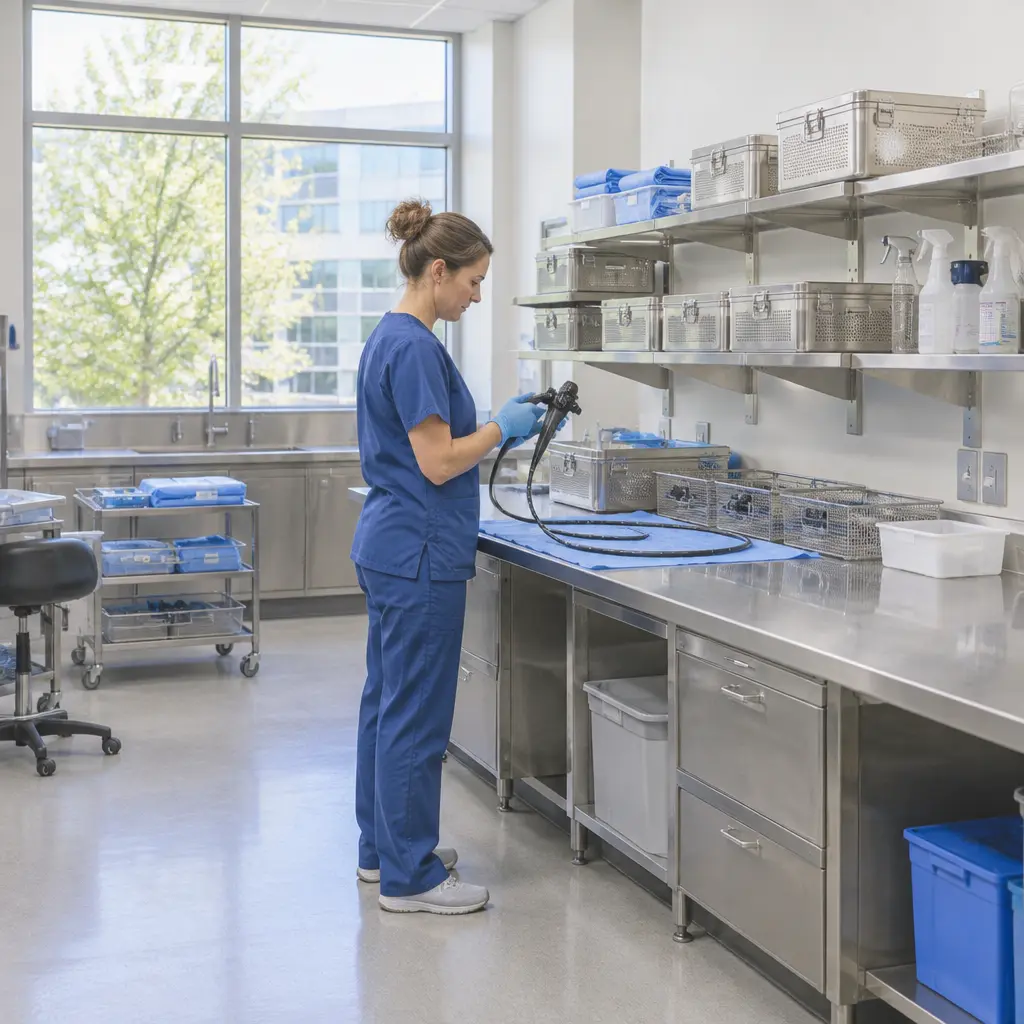
Poor device hygiene in hospitals means failing to clean, disinfect, inspect, or manage reusable medical equipment as required between patients and uses. Its costs extend beyond infection risk: contaminated devices can contribute to patient harm, treatment delays, additional clinical work, regulatory exposure, and avoidable spending. The Centers for Disease Control and Prevention (CDC) reports that about one in 31 U.S. hospital patients has at least one healthcare-associated infection on any given day. The consequences are not attributable to device hygiene alone, but the figure underscores why hospitals must treat cleaning, disinfection, sterilization, and equipment tracking as connected parts of patient safety.
Poor device hygiene raises infection and patient-safety risks
Medical-device hygiene is the set of practices used to prevent equipment from transferring microorganisms or other contaminants to patients, staff, or the care environment. The CDC’s guideline for disinfection and sterilization in healthcare facilities describes appropriate processing as dependent on the device’s intended use, the risk associated with that use, and the manufacturer’s instructions. In practical terms, hygiene is not simply wiping equipment: it includes choosing the correct process, carrying it out reliably, and documenting or verifying it when required.
The risk varies by device. A blood-pressure cuff used on intact skin does not require the same processing as an instrument entering sterile tissue. The CDC’s Spaulding classification groups reusable patient-care equipment as critical, semicritical, or noncritical, with sterilization, high-level disinfection, or lower-level disinfection generally required according to the category and device instructions. Poor hygiene can mean using the wrong level of processing, missing a cleaning step, or returning equipment to service before it is ready.
Cross-contamination from shared equipment
Cross-contamination occurs when microorganisms are transferred between patients or surfaces, including through shared equipment such as thermometers, stethoscopes, mobile workstations, and monitoring devices. The CDC identifies contaminated equipment and environmental surfaces as potential contributors to pathogen transmission in healthcare settings. The practical danger is greatest when staff assume an item is clean without a reliable process to confirm that it was disinfected between uses.
Research has documented contamination on commonly handled hospital equipment, but contamination does not automatically mean a patient will develop an infection. Risk depends on the organism, the device, how it is used, and the patient’s vulnerability. The distinction matters: hygiene programs should reduce transmission opportunities without overstating what a single culture result proves.
Reprocessing failures involving reusable instruments
Reprocessing is the sequence of steps that makes a reusable device safe for its next use. Depending on the device, this may include point-of-use precleaning, transport, manual or automated cleaning, inspection, disinfection or sterilization, packaging, and storage. The U.S. Food and Drug Administration (FDA) emphasizes that reusable-device manufacturers must provide validated reprocessing instructions. If instructions are unclear, unavailable, or difficult to follow, facilities may struggle to achieve reliable cleaning.
The FDA has warned that some complex devices, including certain duodenoscopes, can be difficult to clean and may retain biological material despite reprocessing. This history prompted stronger attention to device design, validated instructions, inspection, and alternative technologies. It illustrates why a hospital cannot treat sterilization as a substitute for cleaning: residual soil can interfere with downstream disinfection or sterilization.
Poor device hygiene increases financial and operational costs
The cost of poor hygiene includes direct expenses, such as treatment and outbreak response, as well as less visible operational burdens: staff time, equipment downtime, delayed procedures, and investigation. The CDC estimates that healthcare-associated infections cost U.S. hospitals billions of dollars annually, although the total varies by infection type, measurement method, and year. These estimates cover infections broadly and should not be interpreted as costs caused solely by device contamination.
Treatment, extended stays, and avoidable resource use
When an infection is linked to care, a patient may need additional testing, antimicrobial treatment, isolation, or a longer hospital stay. Those needs consume clinical resources and can complicate recovery, especially for people who are critically ill, immunocompromised, or undergoing invasive procedures. The Agency for Healthcare Research and Quality (AHRQ) notes that healthcare-associated infections can cause substantial patient harm and increase the use of healthcare resources.
The financial effect is not a uniform price per infection. It depends on the infection, severity, payer arrangements, and whether the additional care is reimbursed. A useful hospital analysis therefore tracks local infection rates, investigation findings, length of stay, treatment costs, and device-processing failures rather than applying a single national estimate to every event.
Outbreak investigations and equipment downtime
A suspected device-associated cluster can trigger patient tracing, laboratory testing, staff interviews, environmental sampling, equipment quarantine, and review of cleaning records. Even when an investigation finds no confirmed transmission, taking devices out of service can disrupt workflows and require rentals, replacements, or rescheduling. A 2015 CDC report on infections associated with contaminated duodenoscopes documented the complexity of investigating and controlling transmission risks involving reusable devices.
Operational costs also arise from routine processing failures. If equipment is unavailable because cleaning and turnaround are poorly coordinated, staff may spend time searching for alternatives or delay care. A simple visual for a hospital quality report could compare “clean-to-ready” turnaround time, device availability, and documented cleaning compliance by unit, making it easier to identify where hygiene practices are also creating capacity problems.
Regulatory, legal, and reputational exposure
Hospitals must follow applicable infection-prevention requirements, device instructions, and accreditation standards. Failures can lead to corrective actions, reporting obligations, litigation risk, or loss of public confidence, depending on the circumstances. The Centers for Medicare & Medicaid Services (CMS) Conditions of Participation require hospitals to maintain an infection-control program, while the Joint Commission’s standards address infection prevention and the management of equipment and the care environment.
These consequences are not automatic whenever a cleaning lapse occurs. They depend on the facts, applicable rules, and the hospital’s response. However, incomplete records can make it harder to show that required processes were followed, so documentation is an essential control—not merely administrative paperwork.
Reliable device hygiene depends on people, processes, and design
Hospitals can reduce risk by treating device hygiene as a system rather than an individual task. The system must connect purchasing, manufacturer instructions, staffing, training, cleaning supplies, workflow design, monitoring, and corrective action. This approach helps explain why a technically correct protocol may still fail if staff cannot access the right disinfectant or if clean and dirty equipment follow the same route.
Standardized protocols and manufacturer instructions
A protocol defines who cleans a device, when cleaning occurs, what product and contact time are required, and how the device is handled afterward. Staff should use the manufacturer’s instructions for use (IFUs), because disinfectants, materials, and device designs differ. The FDA recommends that healthcare facilities follow validated reprocessing instructions and raise concerns when instructions are inadequate or cannot be followed in practice.
A strong protocol distinguishes between immediate point-of-use actions and full reprocessing. It also identifies equipment that requires specialized training or centralized processing. Hospitals should review protocols when devices, cleaning products, or manufacturer instructions change, and ensure staff can readily find the current version at the place of work.
Training, staffing, and accountability
Training translates written procedures into repeatable practice. It should include device-specific demonstrations, competency checks, and refreshers when procedures change or audits identify problems. The CDC’s infection-prevention guidance emphasizes education and competency as components of effective infection-control programs. Hospitals should also make responsibility explicit: ambiguity about whether nurses, environmental-services staff, or central-processing teams clean a shared device can leave gaps between roles.
Staffing and workload matter because rushed turnover can encourage shortcuts. Leaders can reduce pressure by providing enough equipment, clear dirty-to-clean pathways, accessible supplies, and realistic turnaround expectations. Reporting systems should make it safe to flag a missed cleaning step or damaged device before it reaches another patient.
Audits, monitoring, and traceability
Monitoring checks whether the process is being followed and whether corrective action works. Hospitals may combine direct observation, cleaning logs, equipment tracking, audits, and appropriate objective checks. No single measure proves that every device is safe: a completed checklist, for example, records a step but does not necessarily validate the effectiveness of the entire process.
Useful indicators include cleaning compliance by device and unit, reprocessing deviations, equipment-related infection signals, turnaround time, and the proportion of devices with complete traceability where tracking is appropriate. The CDC’s National Healthcare Safety Network provides standardized surveillance methods for several healthcare-associated infections, helping facilities monitor infection trends; surveillance data should be interpreted alongside clinical review and investigation rather than used as a stand-alone measure of device hygiene.
A practical hospital response to poor device hygiene
Hospitals should begin with a risk-based inventory of reusable devices, identifying which items are shared, which require specialized reprocessing, and where responsibility or instructions are unclear. Infection prevention, nursing, sterile processing, environmental services, clinical engineering, procurement, and frontline staff should jointly review the workflow. This cross-functional approach is especially important when a device crosses departments or is cleaned by different teams at different stages.
- Confirm that current manufacturer instructions are available and workable for each device.
- Map the device’s path from use through cleaning, disinfection or sterilization, storage, and return to service.
- Train and assess staff on the specific steps they perform, including contact times and safe handling.
- Measure compliance and equipment availability, investigate recurring failures, and document corrective actions.
- Escalate suspected device-associated infections promptly through infection prevention and the relevant public-health or regulatory channels.
The most effective improvement plans address both safety and practicality. If staff repeatedly miss a cleaning step, leaders should examine whether instructions are confusing, supplies are missing, staffing is inadequate, or equipment design makes the step difficult—not simply repeat the training. In complex cases, hospitals should consult infection-prevention specialists, device manufacturers, and public-health authorities.
Conclusion: device hygiene is a patient-safety and cost-control priority
Poor device hygiene can create opportunities for cross-contamination, compromise reusable-device reprocessing, and add treatment, investigation, downtime, and compliance costs. CDC infection estimates show the wider burden of healthcare-associated infections, while FDA experience with complex reusable devices demonstrates why validated instructions, effective cleaning, and reliable oversight matter. Hospitals can reduce risk through clear protocols, competent staffing, practical workflows, monitoring, and traceable corrective action.
Hospital leaders should review device-processing risks with frontline teams, audit high-risk workflows, and make it easy to report and correct failures. For further guidance, consult current CDC infection-prevention resources, FDA reusable-device reprocessing guidance, and applicable CMS and accreditation requirements.
Sources: Centers for Disease Control and Prevention, “Healthcare-Associated Infections (HAIs),” https://www.cdc.gov/healthcare-associated-infections/about/index.html; Centers for Disease Control and Prevention, “Guideline for Disinfection and Sterilization in Healthcare Facilities,” https://www.cdc.gov/infection-control/hcp/disinfection-sterilization/index.html; Centers for Disease Control and Prevention, “National Healthcare Safety Network,” https://www.cdc.gov/nhsn/index.html; U.S. Food and Drug Administration, “Reprocessing of Reusable Medical Devices,” https://www.fda.gov/medical-devices/products-and-medical-procedures/reprocessing-reusable-medical-devices; U.S. Food and Drug Administration, “Infections Associated with Reprocessed Duodenoscopes,” https://www.fda.gov/medical-devices/reprocessing-reusable-medical-devices/infections-associated-reprocessed-duodenoscopes; Agency for Healthcare Research and Quality, “Healthcare-Associated Infections,” https://www.ahrq.gov/topics/healthcare-associated-infections.html; Centers for Medicare & Medicaid Services, “State Operations Manual, Appendix A—Survey Protocol, Regulations and Interpretive Guidelines for Hospitals,” https://www.cms.gov/medicare/health-safety-standards/guidance-for-laws-regulations/hospitals; Centers for Disease Control and Prevention, Epstein et al., “New Delhi metallo-β-lactamase-producing carbapenem-resistant Enterobacteriaceae associated with exposure to duodenoscopes,” MMWR, 2015, https://www.cdc.gov/mmwr/preview/mmwrhtml/mm6408a4.htm.