
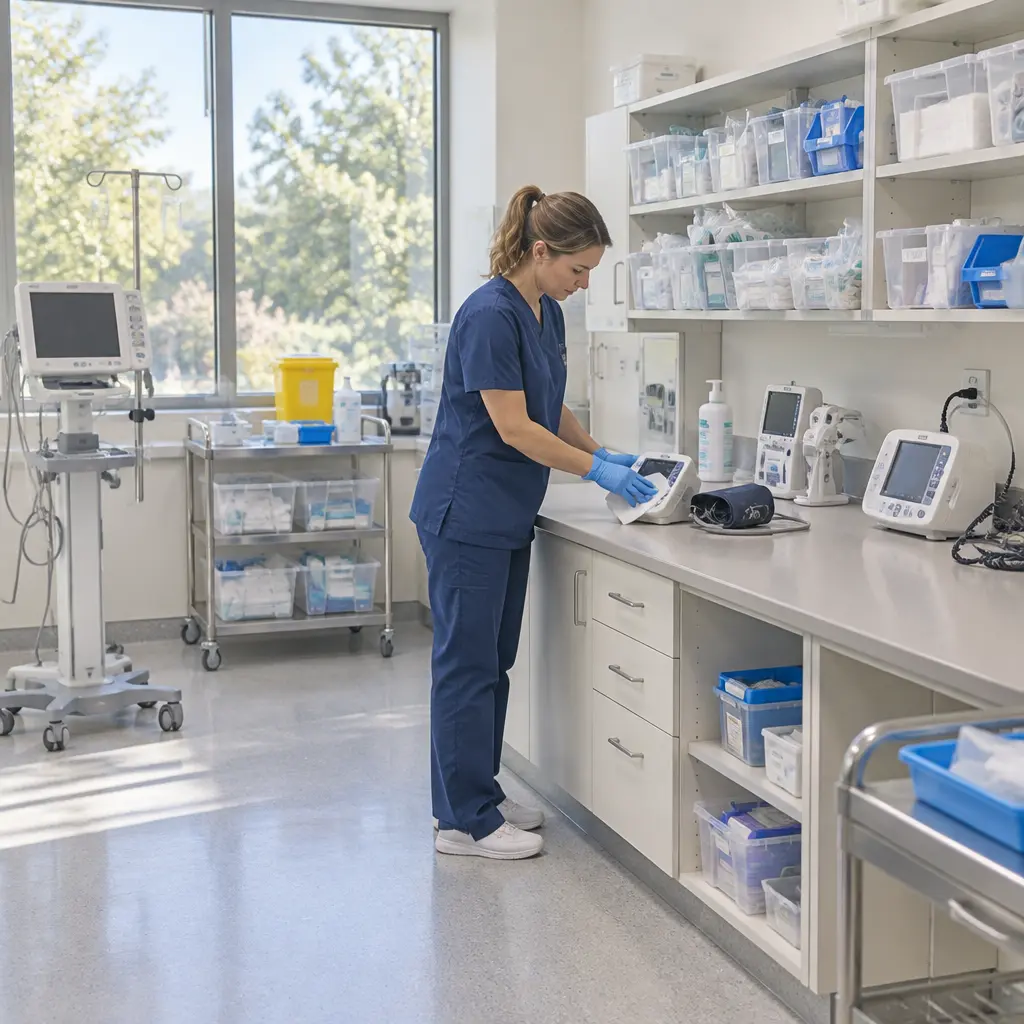
Hospitals keep medical devices safe between patients through a controlled cycle of cleaning, disinfection or sterilization, inspection, and documentation. These steps—guided by the device manufacturer’s instructions and the level of infection risk—help prevent pathogens from traveling on equipment such as blood-pressure cuffs, thermometers, and surgical instruments. The Centers for Disease Control and Prevention (CDC) identifies contaminated equipment and surfaces as possible routes of healthcare-associated infection; its guidance therefore emphasizes matching reprocessing to how a device is used. Safety also depends on staff training, clear workflows, and checks that confirm equipment is ready for the next patient.
Reprocessing standards define how hospitals keep medical devices safe
Medical-device reprocessing is the set of procedures used to make reusable equipment safe for its next use. The U.S. Food and Drug Administration (FDA) describes reprocessing reusable medical devices as a process that includes cleaning and, when appropriate, disinfection or sterilization. The exact method depends on the device’s intended use, design, and manufacturer’s validated instructions—not simply on a hospital’s preferred routine.
A central framework is the Spaulding classification, developed by physician Earle H. Spaulding and widely used in infection prevention. It groups devices by the infection risk associated with their intended contact with the body. CDC guidance links each category to a minimum level of reprocessing: critical devices require sterilization; semicritical devices require at least high-level disinfection; and noncritical devices generally require cleaning and low-level disinfection.
Critical devices: sterilization
Critical devices enter sterile tissue or the vascular system. Examples include many surgical instruments and implants. They must be sterilized, a validated process designed to destroy all forms of microbial life, including bacterial spores. Hospitals commonly use steam sterilization for compatible items; heat-sensitive devices may require another validated method, such as a low-temperature process. Staff follow the device and sterilizer manufacturers’ instructions for cleaning, packaging, cycle selection, and load release.
Semicritical devices: high-level disinfection
Semicritical devices contact mucous membranes or nonintact skin but do not ordinarily enter sterile tissue. Examples can include certain endoscopes and respiratory-therapy equipment. CDC guidance calls for at least high-level disinfection after cleaning; sterilization is preferred when the device can tolerate it. High-level disinfection eliminates all microorganisms except, in some circumstances, large numbers of bacterial spores. Because narrow channels and complex surfaces can retain soil, the cleaning step and the device-specific procedure are essential.
Noncritical devices: cleaning and low-level disinfection
Noncritical devices touch intact skin rather than mucous membranes or sterile areas. Examples include blood-pressure cuffs, stethoscopes, and some monitors. CDC guidance generally recommends cleaning followed by low-level disinfection, using a compatible product and its specified contact time. Equipment used on a patient with a particular infection may need additional precautions under facility policy and applicable public-health guidance.
This risk-based classification sets the target level of processing. The next challenge is carrying it out reliably, since even the correct disinfectant or sterilizer cannot compensate for missed cleaning, an incompatible chemical, or a skipped step.
Cleaning and disinfection remove contamination between uses
Cleaning removes visible soil and organic material, usually with water and detergent or an enzymatic cleaner. It is a necessary first step because remaining blood, tissue, or other debris can interfere with later disinfection or sterilization. Disinfection then inactivates many or all disease-causing microorganisms on equipment, depending on the level and method. These terms are not interchangeable: disinfection does not necessarily destroy bacterial spores, while sterilization is intended to eliminate all microbial life.
Between-patient cleaning of shared equipment
Reusable equipment that moves between patients is cleaned and disinfected according to its risk category, instructions for use, and hospital policy. Staff pay attention to high-touch areas such as handles, buttons, cables, and surfaces that contact the patient. They use approved products compatible with the device, observe the required wet contact time, and allow surfaces to dry when the product instructions require it. Disposable components are discarded as directed rather than reused.
Reprocessing complex devices
Devices with internal channels, joints, or delicate components may need specialized manual cleaning, flushing, leak testing, automated processing, or drying. Endoscopes are a prominent example: their intricate channels can make effective cleaning challenging. The CDC’s guidance for flexible gastrointestinal endoscopes emphasizes meticulous cleaning before disinfection and adherence to manufacturer instructions. Hospitals may use automated endoscope reprocessors, but automation does not remove the need for required manual steps or trained oversight.
Environmental services and clinical staff coordination
Safe turnaround depends on clear responsibility. Clinical staff typically identify used equipment and prepare it for transport; trained reprocessing or environmental-services staff carry out assigned cleaning and disinfection; and teams verify that processed equipment is stored or returned without recontamination. The precise division of work varies by device and institution. Written procedures, training, and clear labeling help prevent uncertainty about whether an item is clean, used, or awaiting processing.
Cleaning and disinfection address contamination on the device, while sterilization services add controlled processes for items that require the highest level of microbial elimination. Both depend on tracking and quality checks that show whether the prescribed process was completed.
Sterilization services verify that reusable instruments are ready
Central sterile processing departments receive, clean, inspect, package, sterilize, and distribute reusable instruments. The Association for the Advancement of Medical Instrumentation (AAMI) publishes technical standards and recommended practices used by healthcare organizations to guide sterilization and sterile processing. Hospitals also follow FDA-cleared device and equipment instructions, occupational safety requirements, and relevant accreditation and regulatory expectations.
Inspection, packaging, and cycle control
Before sterilization, staff inspect instruments for soil, damage, and function, then package them in materials suited to the chosen process. Loads are arranged so the sterilant can reach the items. Staff select a validated cycle for the device and load, and check cycle records and indicators before release. A failed or incomplete cycle is not treated as successful; affected items are held and investigated under facility procedures.
Monitoring with physical, chemical, and biological indicators
Sterilization monitoring uses complementary checks. Physical monitors record cycle parameters such as time, temperature, and pressure. Chemical indicators show whether specified process conditions were reached at a particular location. Biological indicators use resistant microorganisms to test whether a sterilization process can achieve its intended microbial kill under defined conditions. CDC guidance recommends routine monitoring and documentation; biological-indicator testing frequency and circumstances are governed by applicable standards, equipment instructions, and facility policy.
Traceability and recall readiness
Traceability links a sterilization load to its contents, cycle record, and distribution. Hospitals may use instrument-tracking systems or documented batch records to identify which devices were processed together and where they went. If monitoring indicates a problem, traceability helps staff determine whether items must be quarantined, recalled, or reprocessed. It also supports audits and investigation of suspected infections or equipment failures.
A recorded cycle is useful only if staff can interpret it and act on exceptions. That is why training, workflow design, and equipment maintenance are part of infection prevention rather than separate administrative concerns.
Staff training and quality systems reduce reprocessing errors
A quality system turns written instructions into consistent practice. It includes assigned responsibilities, competency-based training, access to current instructions, routine audits, maintenance, and a method for reporting and correcting deviations. CDC infection-control guidance stresses that healthcare personnel need appropriate training in the tasks they perform, while FDA guidance highlights the importance of following device-specific reprocessing instructions.
Competency and written procedures
Staff who clean, disinfect, or sterilize devices need training for the equipment and process involved. Competency checks can assess whether they can identify the device, choose the correct procedure, use protective equipment, observe contact times, and document completion. Clear procedures also explain what to do when instructions are missing, a device is damaged, or a process indicator fails.
Manufacturer instructions and device design
The manufacturer’s instructions for use specify validated reprocessing steps, including compatible detergents, disassembly, rinsing, drying, and limits on reuse. The FDA has noted that reusable devices can be difficult to clean and that inadequate or unclear instructions can create reprocessing challenges. Hospitals should evaluate whether they can reliably follow the instructions before introducing a device and seek clarification from the manufacturer when directions are incomplete or impractical.
Audits, incident response, and continuous improvement
Audits can compare actual practice with written procedures, including whether cleaning steps are completed, records are accurate, and equipment is stored appropriately. When staff identify a lapse, a timely response may include stopping use, isolating affected items, assessing patient risk, notifying infection prevention and leadership, and documenting corrective action. The appropriate response depends on the type of failure and clinical circumstances; suspected device-related infection should be evaluated with infection-prevention and public-health expertise.
Device safety depends on consistent execution
Hospitals protect patients between uses by matching reprocessing to device risk, cleaning before disinfection or sterilization, following manufacturer instructions, monitoring processes, and maintaining traceable records. The Spaulding categories explain why a surgical instrument, endoscope, and blood-pressure cuff do not receive identical treatment. Sterile-processing teams, clinical staff, environmental-services personnel, and infection-prevention professionals each contribute to a safe handoff.
For patients and healthcare workers, the practical takeaway is that a device should not be assumed ready simply because it looks clean. Hospitals should invest in training, compatible equipment and supplies, clear procedures, and a culture in which staff can report concerns without delay. Readers seeking further detail can consult CDC infection-control guidance, FDA information on reusable medical devices, and AAMI standards through their official publications.
Sources: Centers for Disease Control and Prevention, Guideline for Disinfection and Sterilization in Healthcare Facilities, https://www.cdc.gov/infection-control/hcp/disinfection-sterilization/; Centers for Disease Control and Prevention, Flexible Gastrointestinal Endoscopes, https://www.cdc.gov/infection-control/hcp/disinfection-sterilization/flexible-gastrointestinal-endoscopes.html; U.S. Food and Drug Administration, Reprocessing of Reusable Medical Devices, https://www.fda.gov/medical-devices/products-and-medical-procedures/reprocessing-reusable-medical-devices; Association for the Advancement of Medical Instrumentation, Standards and Guidelines, https://www.aami.org/standards.