
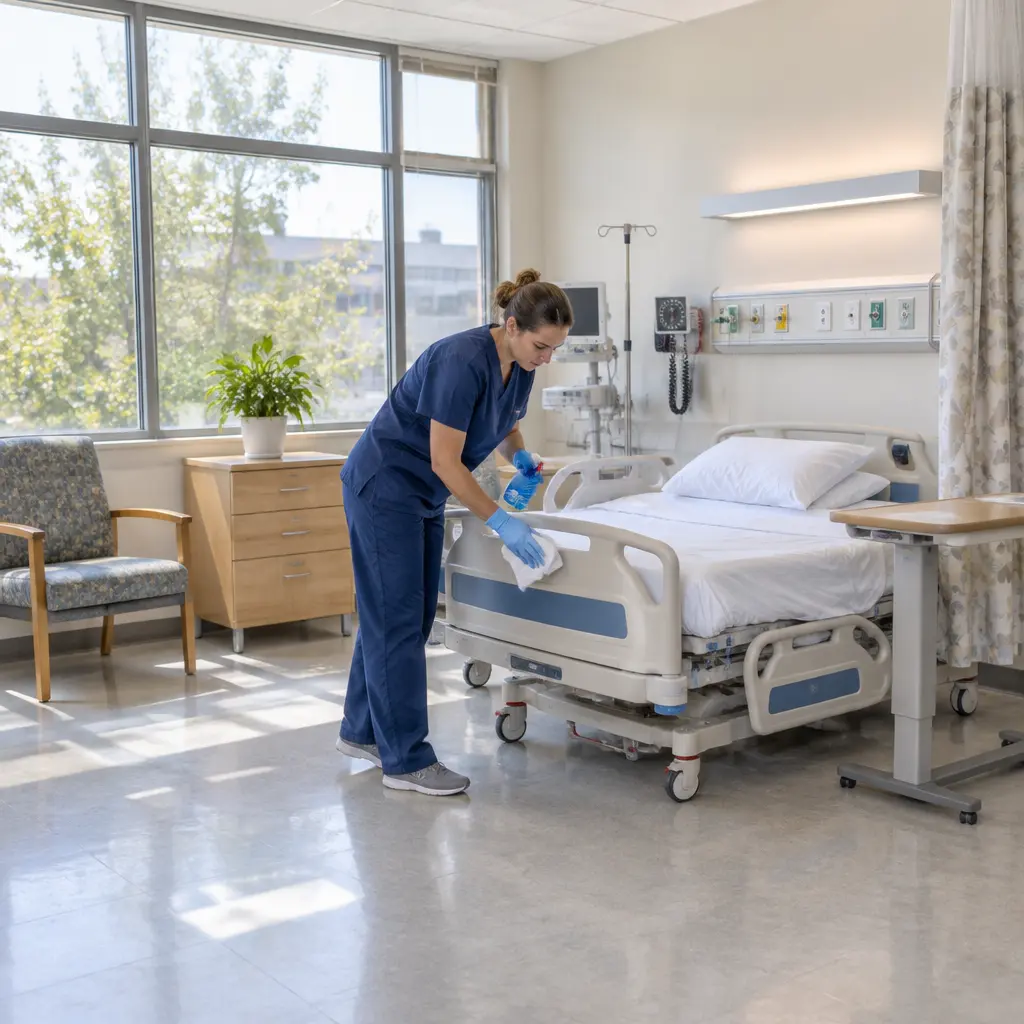
Disinfection in healthcare is the use of chemical or physical processes to inactivate many or all disease-causing microorganisms on inanimate objects, although it does not necessarily destroy bacterial spores. Consistent, correctly performed disinfection helps interrupt the spread of healthcare-associated infections (HAIs), protect patients and staff, and limit outbreaks—especially when combined with hand hygiene, cleaning, sterilization where required, and appropriate use of personal protective equipment. The scale of the need is substantial: the World Health Organization estimates that, on any given day, about 1 in 10 patients in acute-care hospitals in high-income countries and 1 in 15 in low- and middle-income countries acquire at least one HAI. This article explains what healthcare disinfection means, how it differs from cleaning and sterilization, which methods and surfaces require particular attention, and how monitoring and real-world evidence support reliable practice.
Disinfection and healthcare safety: defining the essential practice
The U.S. Centers for Disease Control and Prevention (CDC) defines disinfection as a process that eliminates many or all pathogenic microorganisms on inanimate objects, except bacterial spores, in most circumstances. Disinfection is therefore a risk-reduction measure, not a promise that an object is sterile. Its effectiveness depends on selecting a method appropriate to the item and organism, removing soil first, using the product at its specified concentration, keeping the surface wet for the required contact time, and following the manufacturer’s instructions.
The term covers several related practices, including routine environmental-surface disinfection, targeted disinfection after contamination, and high-level disinfection of certain reusable medical devices. These are not interchangeable. CDC’s Spaulding classification links the required level of processing to how an item is used: critical devices that enter sterile tissue or the vascular system require sterilization; semicritical devices that contact mucous membranes or nonintact skin generally require at least high-level disinfection; and noncritical items that contact intact skin require cleaning and, when indicated, low- or intermediate-level disinfection.
Cleaning, disinfection, and sterilization are different steps
Cleaning physically removes visible soil and organic material, usually with water and detergent or an enzymatic cleaner. It is essential because residue can interfere with a disinfectant’s action. Disinfection inactivates specified microorganisms but may leave spores; sterilization is a validated process intended to destroy all forms of microbial life, including spores. For reusable instruments, the correct sequence and level of processing depend on the device’s intended use and its manufacturer’s reprocessing instructions.
Why consistency matters
Consistency means that staff perform the right procedure at the right time, on the right surface or device, using the right product and contact time. A single missed step—such as disinfecting over visible soil or allowing a surface to dry before the label’s contact time has elapsed—can undermine the process. Reliable routines are especially important because patients, staff, visitors, and equipment move continually through shared clinical spaces.
The WHO’s global estimates show that HAIs affect patients across health-system income groups. Those figures describe the burden of infection overall, not infections attributable to contaminated surfaces alone; transmission can also involve hands, devices, air, water, and other routes. Disinfection is one important layer in a broader infection-prevention system.
Disinfection methods and settings in healthcare
Healthcare facilities use different disinfection approaches according to the surface, device, likely pathogen, and level of risk. A product suitable for a bed rail may be inappropriate for a delicate instrument, and a method used for a reusable device must be compatible with its design. Facilities should follow national guidance, product labeling, and device-manufacturer instructions rather than relying on a single universal method.
Environmental surfaces and shared equipment
Environmental surfaces include frequently touched objects such as bed rails, call buttons, door handles, worktops, and shared clinical equipment. CDC guidance distinguishes routine cleaning and disinfection from more frequent or targeted procedures for high-touch surfaces and areas occupied by patients with particular infections. The appropriate product and frequency should be based on local policy, the care environment, and the organism or contamination risk.
A systematic review and meta-analysis published in the American Journal of Infection Control by Anderson and colleagues found that enhanced terminal-room disinfection strategies could reduce the incidence of certain multidrug-resistant organism infections among patients admitted to rooms previously occupied by affected patients. The findings support the value of reliable environmental hygiene while also showing that outcomes depend on the intervention, pathogen, setting, and adherence—not simply on the presence of a disinfection product.
Medical devices and Spaulding risk categories
The Spaulding system provides a practical framework for selecting processing levels. Critical items, such as surgical instruments, enter sterile tissue or the vascular system and must be sterilized. Semicritical items, including some endoscopes and respiratory equipment, contact mucous membranes or nonintact skin and require at least high-level disinfection when sterilization is not appropriate. Noncritical items, such as blood-pressure cuffs, contact intact skin and are generally managed with cleaning and suitable low- or intermediate-level disinfection.
This classification is a starting point, not a substitute for device-specific instructions. CDC emphasizes that reusable medical equipment must be reprocessed according to its intended use and the manufacturer’s validated instructions. Inadequate processing can expose patients to pathogens, while incompatible chemicals or procedures can damage devices and compromise future reprocessing.
Chemical and no-touch technologies
Chemical disinfectants include products formulated with active ingredients such as alcohols, chlorine compounds, hydrogen peroxide, or quaternary ammonium compounds. Their activity differs by organism and use conditions. Staff must check that a product is approved or registered for the intended use, observe required dilution and contact time, and use the protective equipment specified on its label.
No-touch technologies, including ultraviolet-C devices and vaporized or aerosolized hydrogen peroxide systems, may supplement manual cleaning and disinfection in selected settings. They do not remove dirt and should not be treated as replacements for routine cleaning, correct chemical use, or hand hygiene. Their effectiveness depends on factors such as room configuration, exposure time, shadowing, and validated operating procedures.
Consistent disinfection reduces transmission risks
Disinfection helps break potential pathways by reducing viable microorganisms on surfaces and equipment that may be touched by patients or staff. This matters particularly for organisms that can persist in the care environment or spread through contaminated hands and shared devices. However, evidence should be interpreted carefully: environmental contamination is one component of infection risk, and disinfection works best as part of a coordinated prevention program.
Reducing healthcare-associated infection risk
HAIs can lead to longer hospital stays, additional treatment, disability, and death. The WHO reports that effective infection prevention and control programs can reduce healthcare-associated infections by up to 70% in some contexts. This is a finding about comprehensive infection prevention and control—not disinfection alone—and reinforces the importance of combining environmental hygiene with hand hygiene, surveillance, safe device care, and staff training.
The CDC’s Environmental Infection Control Guidelines identify cleaning and disinfection as core components of a healthcare facility’s environmental infection-control program. In practice, facilities should tailor procedures to the likelihood of contamination, the vulnerability of patients, and the specific risks associated with the care area.
Protecting patients, staff, and visitors
Patients with weakened immune systems, those undergoing surgery, and people using invasive devices may be especially vulnerable to infection. Staff and visitors can also encounter contaminated surfaces while moving through clinical areas. Clear responsibilities, readily available supplies, and well-designed workflows make it easier to complete disinfection consistently without creating avoidable interruptions or unsafe chemical exposure.
Chemical safety is part of infection prevention. Products should be used only as labeled, never mixed unless the manufacturer explicitly directs it, and stored securely. Appropriate ventilation and personal protective equipment help protect environmental-services workers and clinical staff from irritation, inhalation hazards, and accidental exposure.
Outbreak response and targeted disinfection
During an outbreak, infection-prevention teams may increase cleaning frequency, target high-touch surfaces, specify products with activity against the identified organism, and reinforce reprocessing and isolation procedures. These decisions should be guided by public-health authorities and facility protocols. A targeted response is more effective when teams can identify the suspected transmission route and verify that the selected product and method are suitable.
Implementation, monitoring, and evidence in practice
A written policy alone does not ensure reliable disinfection. Facilities need practical procedures, trained staff, adequate supplies, and feedback that helps teams detect and correct gaps. The process should account for the specific care area, surfaces, devices, product instructions, and the time and staffing available to complete tasks safely.
Training and clear procedures
Training should explain what must be cleaned, which disinfectant to use, how to prepare or dispense it, how long the surface must remain wet, and what personal protective equipment is needed. Staff should also know how to handle spills, contaminated equipment, and products that require special ventilation or disposal. Competency checks and periodic refreshers help maintain correct practice when products, guidance, or workflows change.
Audits and verification
Facilities can assess environmental-cleaning performance through direct observation, fluorescent-marker checks, or other locally selected audit methods. These approaches measure whether cleaning actions were completed on sampled surfaces; they do not, by themselves, prove that a pathogen was eliminated or that infection rates will fall. Microbiological testing may have a role in specific investigations but is not a universal substitute for process monitoring.
The CDC recommends monitoring environmental-cleaning practices as part of a comprehensive program. Results are most useful when shared constructively with staff, connected to practical coaching, and reviewed alongside supply availability and workload. A simple chart can compare the proportion of audited high-touch surfaces cleaned across units or over time, helping managers see where follow-up is needed.
Real-world evidence and its limits
A multicentre randomized trial by Anderson and colleagues, published in The Lancet in 2017, evaluated enhanced terminal-room disinfection after discharge of patients known to carry selected pathogens. The study found that adding ultraviolet-C disinfection to standard terminal cleaning reduced the composite risk of acquiring certain targeted organisms among patients entering those rooms. The result supports carefully selected supplementary measures, but it should not be generalized to every pathogen, room, or facility; manual cleaning and standard disinfection remained foundational.
A useful accompanying graphic would show the infection-prevention chain: correct cleaning, suitable disinfection, appropriate device reprocessing, hand hygiene, monitoring, and feedback. Such a diagram would emphasize that no single intervention can independently guarantee infection prevention.
Conclusion: make reliable disinfection part of everyday care
Healthcare disinfection is a defined, risk-based process that differs from both cleaning and sterilization. Its value depends on matching the method to the surface, device, and likely organism; following product and manufacturer instructions; and sustaining the practice through training, adequate resources, and monitoring. WHO estimates that HAIs affect roughly 1 in 10 acute-care patients in high-income countries and 1 in 15 in low- and middle-income countries, while its evidence on infection-prevention programs underscores the broader potential of coordinated prevention.
Healthcare leaders should review local procedures, confirm that staff have the right products and training, and use audits to identify and address practical barriers. Further reading from the CDC and WHO can help facilities align their policies with current infection-prevention guidance. Consistent disinfection is not a stand-alone solution, but it is an essential part of safer care for patients, staff, and visitors.
Sources: World Health Organization, Global report on infection prevention and control, 2022, https://www.who.int/publications/i/item/9789240051164; Centers for Disease Control and Prevention, Guideline for Disinfection and Sterilization in Healthcare Facilities, 2008, https://www.cdc.gov/infection-control/hcp/disinfection-sterilization/summary-recommendations.html; Centers for Disease Control and Prevention, Environmental Infection Control Guidelines, https://www.cdc.gov/infection-control/hcp/environmental-control/; Anderson, D. J., et al., “Enhanced terminal room disinfection and acquisition and infection caused by multidrug-resistant organisms and Clostridium difficile (the Benefits of Enhanced Terminal Room Disinfection study): a cluster-randomised, multicentre, crossover study,” The Lancet, 2017, https://doi.org/10.1016/S0140-6736(16)31588-4; Anderson, D. J., et al., “Enhanced terminal room disinfection and acquisition and infection caused by multidrug-resistant organisms and Clostridium difficile (the Benefits of Enhanced Terminal Room Disinfection study): a randomized, multicenter, crossover study,” American Journal of Infection Control, 2017, https://doi.org/10.1016/j.ajic.2016.10.019.