
Healthcare equipment disinfection is the use of validated processes to remove or inactivate disease-causing microorganisms on equipment, reducing the risk that care will transmit infection. The right method depends on what the device touches: the Centers for Disease Control and Prevention (CDC) classifies devices by infection risk, while manufacturer instructions specify compatible products, concentration, contact time, and processing steps. This guide explains those risk categories, practical cleaning and disinfection workflows, product selection, staff safety, and quality checks. The stakes are substantial: the World Health Organization estimates that, in acute-care hospitals, about 7 of every 100 patients in high-income countries and 15 of every 100 in low- and middle-income countries acquire at least one healthcare-associated infection during their stay.
Risk classification guides healthcare equipment disinfection
Disinfection is the process of eliminating many or all pathogenic microorganisms on inanimate objects, except bacterial spores in some cases, according to the CDC’s Guideline for Disinfection and Sterilization in Healthcare Facilities. It is not interchangeable with cleaning or sterilization. Cleaning removes soil and organic material; disinfection inactivates specified microorganisms; sterilization destroys all forms of microbial life, including bacterial spores. These steps are related, but the required level depends on the equipment’s intended use.
The CDC’s Spaulding classification provides a practical framework: critical devices enter normally sterile tissue or the vascular system and must be sterile; semicritical devices contact mucous membranes or nonintact skin and require at least high-level disinfection; and noncritical devices contact intact skin or environmental surfaces and generally need low-level disinfection. The CDC reports that noncritical environmental surfaces are commonly disinfected with an Environmental Protection Agency (EPA)-registered hospital disinfectant, following its label. This risk-based approach helps staff match processing intensity to the potential harm of transmission.
Critical equipment: sterilization rather than routine disinfection
Critical equipment includes surgical instruments, implants, and devices that enter sterile body areas. Because contamination could directly cause infection, these items require sterilization, not merely surface disinfection. Steam sterilization is preferred for heat- and moisture-compatible devices; manufacturers may specify other validated methods for heat-sensitive equipment. Before sterilization, devices must be cleaned, inspected, packaged, and processed according to the device and sterilizer instructions. A disinfectant wipe alone is not an acceptable substitute.
Semicritical equipment: high-level disinfection
Semicritical equipment contacts mucous membranes or nonintact skin without ordinarily penetrating sterile tissue. Examples include many endoscopes and respiratory therapy devices. The CDC recommends at least high-level disinfection after thorough cleaning, unless the device is designed to be sterilized. High-level disinfectants are regulated by the U.S. Food and Drug Administration (FDA), and processing must follow the product label and device instructions, including required exposure time, temperature, rinsing, drying, and storage. Complex devices may have channels or joints that require specific cleaning and flushing procedures.
Noncritical equipment: low-level disinfection
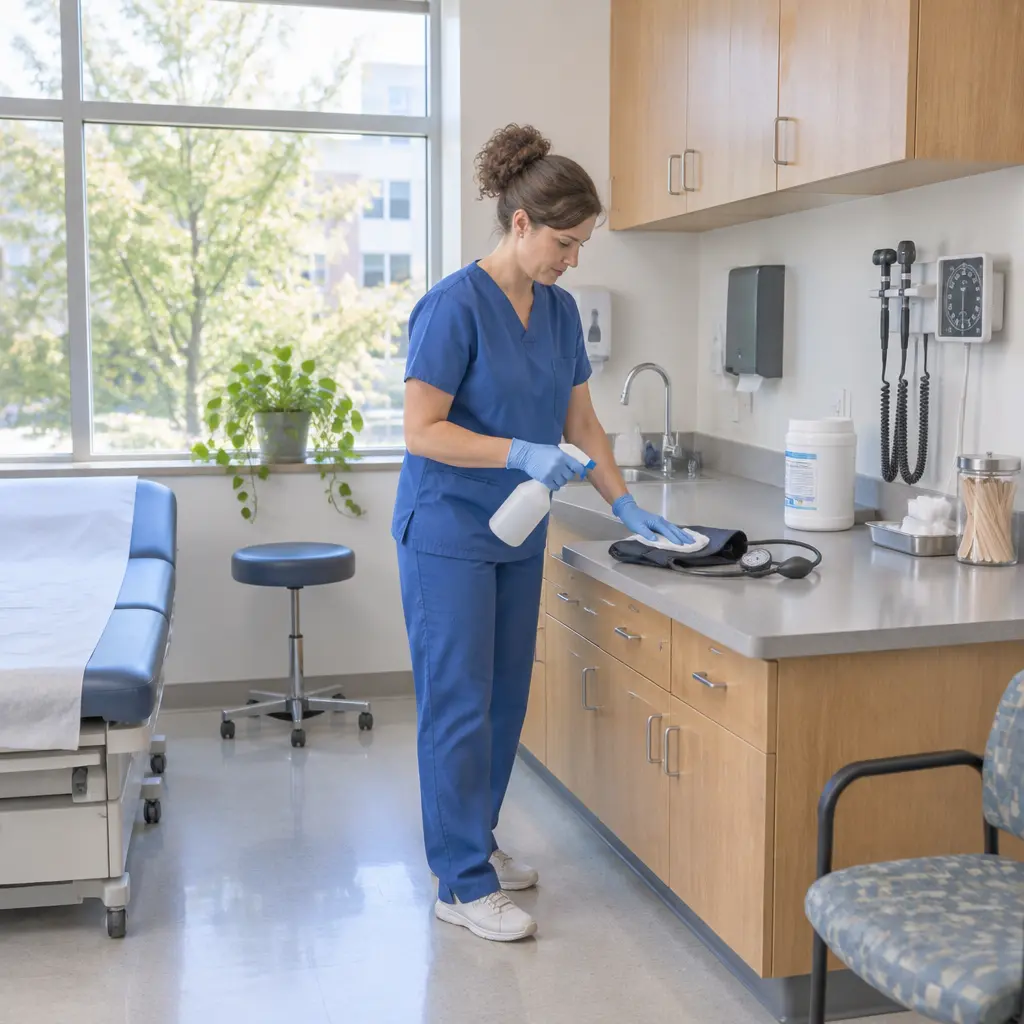
Noncritical equipment touches intact skin or nearby surfaces rather than mucous membranes or sterile tissue. Examples include blood-pressure cuffs, examination tables, and many external monitor components. The CDC advises cleaning and disinfecting these items with an appropriate hospital disinfectant, using the label’s directions. Shared devices should be processed between patients when required by the facility’s protocol and the manufacturer, with prompt attention to visible soil or contamination. Although the infection risk is generally lower than for critical devices, neglected high-touch equipment can still contribute to cross-transmission.
A validated workflow makes equipment disinfection reliable
A disinfectant works only when the full process is performed correctly. CDC guidance emphasizes that cleaning must precede disinfection because blood, tissue, and other organic material can shield microorganisms or interfere with some chemical agents. Staff should use a written, device-specific workflow that identifies who processes the equipment, where processing occurs, which products are permitted, and how completion is recorded. The following sequence connects soil removal to safe return to service.
Prepare and clean the device
Before processing, consult the current manufacturer’s instructions for use (IFU), identify the device and its risk category, and put on the personal protective equipment specified by the task and facility policy. Remove visible soil using the approved method, paying attention to hinges, seams, channels, and other hard-to-reach areas. Do not assume that a disinfectant wipe can replace cleaning. If a device is damaged, cannot be cleaned as directed, or has unclear instructions, remove it from service and seek guidance from the manufacturer or infection prevention team.
Apply the right disinfectant for the required contact time
Select a product whose label supports the intended use and whose chemistry is compatible with the device. EPA-registered products list approved uses and required conditions; FDA-regulated high-level disinfectants have separate requirements for reprocessing reusable medical devices. Keep surfaces visibly wet for the full labeled contact time, rather than wiping them dry early. Never mix products or improvise dilution: incorrect concentration can reduce effectiveness, damage equipment, or expose workers and patients to harmful residues.
Rinse, dry, inspect, and store when required
Some reprocessed devices require rinsing to remove chemical residues, followed by thorough drying and protected storage. These steps are especially important for equipment with internal channels, where retained moisture can support microbial growth or compromise subsequent use. Inspect the device for cleanliness, damage, and functional readiness. For reusable devices requiring high-level disinfection or sterilization, document processing according to facility policy and applicable instructions before release for patient care.
Product choice and staff safety determine effective disinfection
Choosing a product involves more than selecting the broadest antimicrobial claim. The device’s material, intended use, soil type, patient population, and required processing level all matter. CDC guidance calls for following both the medical-device manufacturer’s instructions and the disinfectant label; when directions conflict or compatibility is uncertain, staff should not guess. Infection prevention, sterile processing, occupational health, and procurement teams can jointly evaluate products before adoption.
Match the product to the device and organism risk
A product must be appropriate for the surface or device and used exactly as labeled, including dilution, application method, and contact time. EPA’s List N, for example, identifies products expected to meet EPA’s criteria for use against SARS-CoV-2 when used according to label directions; inclusion does not mean every listed product is suitable for every device. For reusable medical equipment, the device IFU remains essential because chemicals can corrode metals, cloud plastics, degrade seals, or damage electronics. Facilities should maintain an approved-product list that staff can readily consult.
Protect workers from chemical and exposure hazards
Disinfectants can irritate skin, eyes, or airways, and some high-level disinfectants require careful ventilation and exposure controls. The Occupational Safety and Health Administration (OSHA) requires employers to address applicable chemical hazards through measures such as hazard communication, training, and access to safety data sheets. Staff should use the PPE and engineering controls specified for the product and task, avoid spraying when the label or facility policy prohibits it, and report spills or symptoms promptly. Safe handling supports both reliable processing and a healthier workplace.
Monitoring turns policy into dependable practice
A written protocol is only effective if staff can carry it out consistently. The CDC’s Core Infection Prevention and Control Practices recommend education and training appropriate to assigned duties, monitoring adherence, and providing feedback. Facilities can translate these principles into competency checks, direct observation, processing records, and review of device-related incidents. Tracking missed steps—such as inadequate wet contact time or incomplete channel cleaning—helps target corrective action rather than relying on retraining without evidence.
Use audits and competency checks
Competency assessment verifies that staff can identify device risk, locate the correct IFU, prepare the product safely, and complete every processing step. Audits can examine whether equipment is cleaned between uses as required, whether contact time is met, and whether records are complete. Results should be shared with frontline staff and leaders, with clear responsibility for correcting gaps. For complex reprocessing, facilities should follow relevant professional guidance and regulatory requirements in addition to local policies.
Learn from outbreaks and process failures
Outbreak investigations have repeatedly shown that reusable equipment can become a transmission pathway when cleaning or reprocessing is incomplete. The CDC has documented infections associated with contaminated duodenoscopes, in part because their complex design can make cleaning and disinfection difficult. This experience led to increased attention to device design, reprocessing instructions, surveillance, and newer approaches such as disposable components or alternative designs. The broader lesson is that a device’s processing needs should be considered throughout procurement, training, use, and maintenance—not only at the disinfecting station.
Conclusion: make disinfection risk-based, documented, and consistent
Healthcare equipment disinfection begins with the device’s risk classification: critical items require sterilization, semicritical items require at least high-level disinfection, and noncritical items generally require appropriate low-level disinfection. Effective processing depends on prior cleaning, compatible products, labeled contact times, device-specific instructions, worker protection, and monitoring. With WHO reporting substantial healthcare-associated infection burdens across hospital settings, reliable equipment processing is an essential part of patient safety. Review your facility’s approved-product list and device instructions, verify staff competency, and involve infection prevention or sterile processing specialists whenever requirements are uncertain.
Sources: Centers for Disease Control and Prevention, Guideline for Disinfection and Sterilization in Healthcare Facilities, https://www.cdc.gov/infection-control/hcp/disinfection-sterilization/; Centers for Disease Control and Prevention, Core Infection Prevention and Control Practices for Safe Healthcare Delivery in All Settings, https://www.cdc.gov/infection-control/hcp/core-practices/; World Health Organization, Health care-associated infections, https://www.who.int/news-room/fact-sheets/detail/health-care-associated-infections; U.S. Environmental Protection Agency, List N: Disinfectants for Coronavirus (COVID-19), https://www.epa.gov/pesticide-registration/list-n-disinfectants-coronavirus-covid-19; U.S. Occupational Safety and Health Administration, Hazard Communication, https://www.osha.gov/hazcom.