
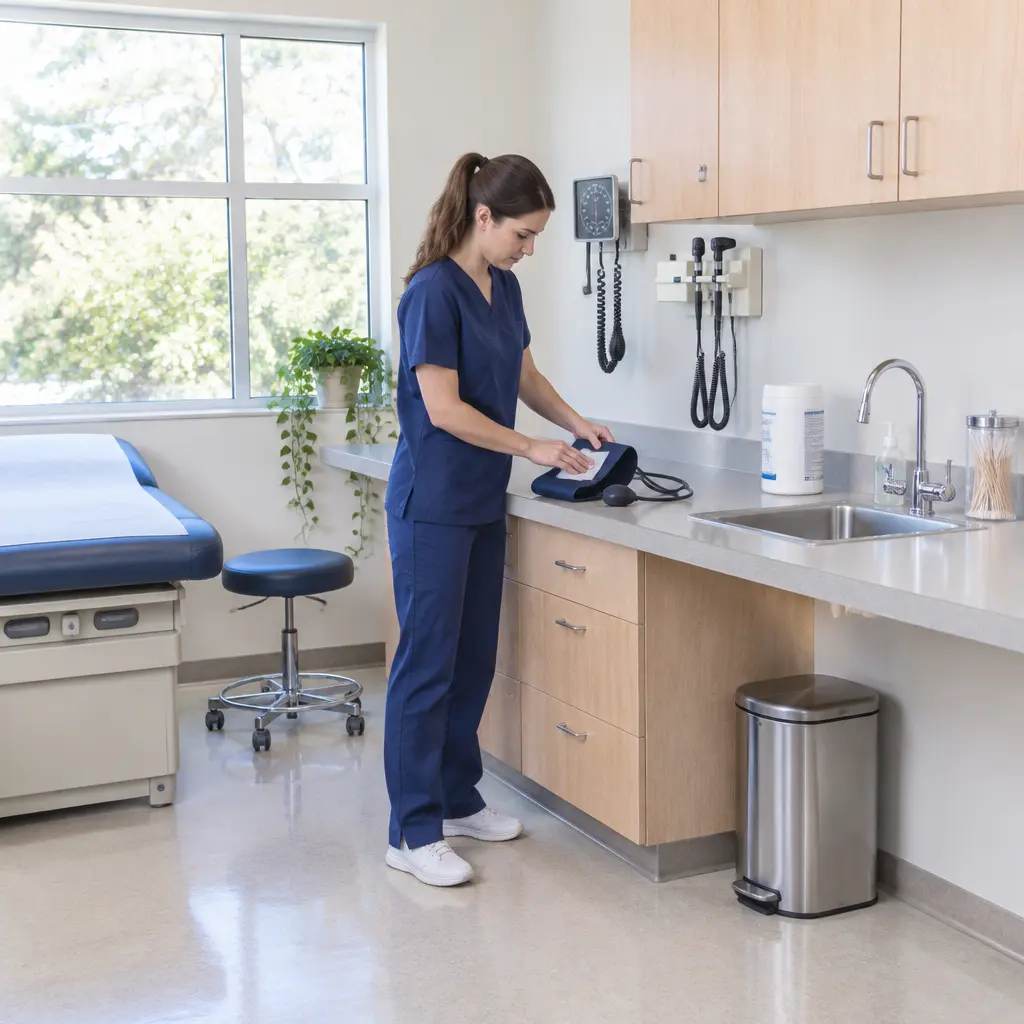
Medical-device disinfection is the process of reducing or inactivating disease-causing microorganisms on reusable equipment, but the right frequency depends on how the device is used, what it contacts, and its manufacturer’s instructions. In practice, devices that touch only intact skin are generally cleaned and disinfected between patients; equipment that contacts mucous membranes or nonintact skin requires at least high-level disinfection between uses; and devices entering sterile tissue or the bloodstream must be sterilized before each use. These distinctions follow the Spaulding classification used by the U.S. Centers for Disease Control and Prevention (CDC). Because contaminated equipment can contribute to healthcare-associated infections, staff should also disinfect shared devices promptly when visibly soiled and follow product labels, facility protocols, and device instructions for use.
Disinfection Frequency and Medical-Device Risk Classification
The CDC describes disinfection as a process that eliminates many or all pathogenic microorganisms on inanimate objects, except bacterial spores in some cases. It is not interchangeable with cleaning or sterilization: cleaning removes soil and organic material, disinfection inactivates specified microorganisms, and sterilization destroys all forms of microbial life, including spores. The frequency and level of reprocessing are determined primarily by a device’s intended use and infection risk—not by a universal daily or weekly schedule.
The CDC’s Spaulding framework divides reusable devices into critical, semicritical, and noncritical categories. This classification is central to deciding what to do between patients, after contamination, and before storage. A device’s manufacturer instructions for use (IFU) provide the specific compatible products, method, contact time, and any required disassembly or drying steps.
Critical devices: sterilize before every use
Critical devices enter normally sterile tissue or the vascular system. Examples include surgical instruments, implants, and certain cardiac or urinary catheters. The CDC recommends sterilization for critical items; they must be sterilized before each patient use, not merely wiped or disinfected. Reprocessing must follow the device and sterilizer IFUs, including cleaning, packaging, cycle selection, and monitoring. If a critical device cannot be sterilized as required, it should not be used.
Semicritical devices: high-level disinfect between patients
Semicritical devices contact mucous membranes or nonintact skin without entering sterile tissue. Examples include many endoscopes, respiratory equipment, and vaginal or rectal probes. The CDC calls for at least high-level disinfection after each patient use; sterilization is preferred when the device can tolerate it. Cleaning must precede disinfection because organic material can shield microorganisms and interfere with the process. Staff must observe the disinfectant’s labeled concentration and contact time and any drying, rinsing, or storage instructions required by the device IFU.
Noncritical devices: disinfect between patients and when contaminated
Noncritical devices touch intact skin or do not directly touch patients. Examples include blood-pressure cuffs, stethoscopes, bedside tables, and some monitors. The CDC recommends low-level disinfection for noncritical equipment and surfaces, with the exact product and method guided by the device IFU and facility policy. Shared patient-care equipment should be cleaned and disinfected between patients. Disinfect promptly if visibly soiled or contaminated with blood or body fluids, and follow the product label’s required wet contact time.
Disinfection Frequency by Use and Care Setting
Risk classification sets the minimum reprocessing level, while workflow determines when a device reaches that point. Reusable devices generally require reprocessing after each use and before use on another patient. Between uses, additional cleaning or disinfection may be needed when contamination occurs, during routine room turnover, or as directed by facility infection-prevention procedures.
Shared equipment and patient-care areas
Shared equipment should be disinfected between patients, including items moved between rooms or used by multiple people during a shift. This commonly includes thermometers, pulse oximeters, blood-pressure cuffs, and examination equipment. High-touch room surfaces are a related but separate category: they are cleaned and disinfected according to facility schedules and whenever visibly soiled, with additional precautions for isolation rooms or specific pathogens. Environmental surface schedules should not be substituted for device-specific reprocessing.
Home-use devices
At home, follow the device manufacturer’s cleaning and disinfection instructions rather than applying a hospital schedule to every product. Items used by one person may require cleaning after use or at specified intervals; equipment shared between household members needs an appropriate between-user process. For devices such as nebulizers, glucose meters, and reusable probes, use only compatible products and methods. If instructions are missing, contact the manufacturer or healthcare professional before using a potentially damaging disinfectant.
Visible soil, spills, and suspected contamination
Visible soil is a cue for immediate cleaning, followed by the required disinfection or sterilization process. Blood and body-fluid spills require prompt handling under the facility’s exposure-control and infection-prevention procedures. A wipe that appears dry before the labeled contact time has elapsed may not provide the intended disinfection. Staff should also avoid using a device again until it has completed all required steps and is dry or otherwise ready for use according to its IFU.
Choosing a Disinfectant and Following Instructions
A disinfectant’s effectiveness depends on more than how often it is applied. The CDC advises healthcare facilities to use products registered by the U.S. Environmental Protection Agency (EPA) for the intended purpose and to follow label directions. The label identifies the organisms claimed, surfaces or devices covered, dilution and application directions, and required contact time. Device manufacturers specify which agents and processes are compatible with their equipment.
Contact time and compatibility
Contact time is the period a surface must remain visibly wet for a disinfectant to work as labeled. It varies by product and claim, so there is no single reliable time for all wipes or solutions. Using an incompatible chemical can damage device materials, impair performance, or leave residues. Staff should check both the EPA-registered product label and the device IFU, and should not improvise by mixing products or substituting a stronger chemical.
Cleaning, disinfection, and sterilization are separate steps
Cleaning physically removes dirt and organic matter and is generally required before high-level disinfection or sterilization. Disinfection reduces or inactivates microorganisms to the level specified for the process, while sterilization is required for critical devices. Skipping cleaning, shortening exposure time, or failing to dry and store a processed device correctly can undermine reprocessing. The CDC and the Food and Drug Administration (FDA) emphasize that reusable-device reprocessing must follow validated manufacturer instructions.
Why Consistent Reprocessing Matters
Proper device reprocessing helps interrupt transmission through contaminated equipment and supports prevention of healthcare-associated infections. The CDC estimates that on any given day, about one in 31 U.S. hospital patients has at least one healthcare-associated infection. That figure describes infections broadly; it should not be interpreted as the share caused by reusable devices. Nevertheless, correct cleaning, disinfection, and sterilization are essential components of infection prevention.
The CDC’s Guideline for Disinfection and Sterilization in Healthcare Facilities and its recommendations for disinfection of noncritical environmental surfaces provide a framework for selecting the appropriate level. A practical facility checklist can help staff apply it consistently: identify the device category, consult the IFU, clean first when required, select a compatible registered product, meet the contact time, and document or verify completion according to local policy.
Conclusion: Match Frequency to Device Risk
Medical devices should be disinfected or sterilized at the interval required by their risk category and use: noncritical equipment is generally disinfected between patients and when contaminated; semicritical devices receive at least high-level disinfection after each patient use; and critical devices are sterilized before every use. Cleaning, correct contact time, product compatibility, and manufacturer instructions are essential parts of each process. Healthcare teams and home users should review device IFUs and current infection-prevention guidance rather than rely on a one-size-fits-all schedule. When instructions are unclear, consult infection-prevention staff, the manufacturer, or a qualified clinician before reusing the device.
Sources: Centers for Disease Control and Prevention, Guideline for Disinfection and Sterilization in Healthcare Facilities, 2008, https://www.cdc.gov/infection-control/hcp/disinfection-sterilization/; Centers for Disease Control and Prevention, Disinfection of Healthcare Equipment, https://www.cdc.gov/infection-control/hcp/disinfection-sterilization/healthcare-equipment.html; Centers for Disease Control and Prevention, Healthcare-Associated Infections (HAIs), https://www.cdc.gov/healthcare-associated-infections/about/index.html; U.S. Environmental Protection Agency, Selected EPA-Registered Disinfectants, https://www.epa.gov/pesticide-registration/selected-epa-registered-disinfectants; U.S. Food and Drug Administration, Reprocessing of Reusable Medical Devices, https://www.fda.gov/medical-devices/products-and-medical-procedures/reprocessing-reusable-medical-devices